

Tread-wear indicators (TWI) means the projections within the tread grooves designed to give a visual indication of the degree of wear of the tread.
Tyres With Non Skid Depth (N.S.D.) less than 0.8mm for two and three wheeler tyres and 1.6 mm for other motor vehicles tyres are unsafe to drive. Tyres worn beyond these limits are not fit for use.

Tread wear indicator is a narrow elevation across the longitudinal grooves of the tyre’s tread pattern. On the side of the tyre are the letters TWI (Tread Wear Indicator). When the tyre’s tread depth is down to 1.6 mm (1/16 inch), the tread will be level in height with the tread wear indicators. Change to new tyres as soon as possible. Remember that tyres with little tread depth provide very poor grip in rain and snow.
When you look for minimum tread, remember that this applies to the lowest level of tread you can find, not the highest. Some tyres can have irregular wear, especially if your wheel alignment or air pressure hasn’t been accurate. You need to gauge by the worst results you can find. Remember, it’s your life and the lives of those around you that tyre failure can have a devastating impact on.
How to find Tread-wear indicator?
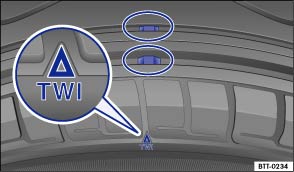
Sometimes these little ridges can be hard to find, particularly if your car is low to the ground and has low-profile tyres. If you can’t see the face of the tyre, manufacturers also mark the sidewall of the tyre with an arrow, their logo, or another defining mark to showcase where the indicators can be found.
These marks will be spaced regularly throughout the circumference of the tyre. If you look at your tyre and the tread is level at any point with these indicators, the tread is at 1.5mm or less and it’s time to change your tyres.
 Tireclopedia
Leave a comment