
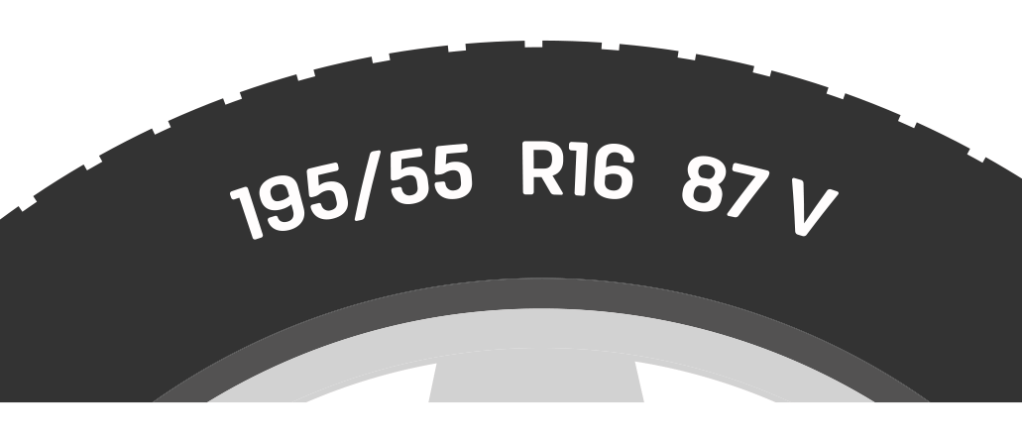
On every tire, there’s a letter representing the maximum rated speed at which the tire can be used. Today, letters such as S, T, U, H, V, Z, W, and Y are most commonly seen. Interestingly, contrary to what might be expected, the complete list of speed symbols is not in alphabetical order. The evolution of these standards over many decades reveals a fascinating history.
Being a professional in the tire industry, I delved deep to uncover the evolution, and here’s what I found. Here’s a summary table, and you can find a more detailed history below.
| Speed Symbol | Km/h | Year of Introduction | Evolution |
|---|---|---|---|
| A1 | 5 | 1983 | For agricultural and industrial tires, it was decided to adopt steps of 5 km/h for speeds below 50 km/h, adding numerical suffixes to the letter “A”. |
| A2 | 10 | ||
| A3 | 15 | ||
| A4 | 20 | ||
| A5 | 25 | ||
| A6 | 30 | ||
| A7 | 40 | ||
| A8 | 45 | ||
| B | 50 | 1983 | Extended the concept of speed symbols to other categories such as commercial and earthmover tires as well. |
| C | 60 | ||
| D | 65 | ||
| E | 70 | ||
| F | 80 | ||
| G | 90 | ||
| J | 100 | ||
| K | 110 | ||
| L | 120 | 1975 | In 1975, a letter was assigned to each existing speed value, possibly in alphabetical sequence, excluding the letters “I” and “O” to prevent confusion with “1” and “0”. To maintain continuity, the letter “S” was assigned to 180 km/h, and the letter “H” to 210 km/h, which was already in use, placing letter H exceptionally out of the alphabetical sequence. |
| M | 130 | ||
| N | 140 | ||
| P | 150 | ||
| Q | 160 | ||
| R | 170 | ||
| S | 180 | ||
| T | 190 | ||
| U | 200 | ||
| H | 210 | ||
| V | 240 | 1987 | In 1975, tires in the “V” speed category were limited and custom-made only for specific high-performance vehicles, thus falling outside the scope of the ECE Regulation. It wasn’t until 1987 that the ECE Regulation expanded its scope to include tires rated up to 240 km/h and introduced the speed symbol “V”. |
| ZR | 240+ | 1992 | In 1992, the “ZR” marking was introduced, which was placed inside the tire size designation (e.g., 235/50 ZR 16), exempting these tires from the requirement to mark load index and speed symbol separately. |
| W | 270 | 1994 | Introduced in 1994 |
| Y | 300 | 1995 | Introduced in 1995. Speed Symbol “X” was excluded from any considerations due to strong resistance from one tyre manufacturer. |
| (Y) | 300+ | 2000 | In 2000, for speeds exceeding 300 km/h, the letter “Z” had to be prefixed to the tire structure symbol (i.e., ZR), and the service description for Y speed was marked on the tires within brackets, such as (91Y). Consequently, tires without any service description were no longer permitted to conform to ECE Regulations. |
History
The first pneumatic tires were manufactured in the 1880s. Over time, multiple standards associations worldwide evolved, each setting regulations and standards that were best suited for their era. These developments have had a profound influence on how tire sizes and specifications are marked on tires today.
1952-1964: Formation of ETRTO
In June 1952, the Economic Commission for Europe of the United Nations (UN-ECE) established Working Party 29 (WP.29) as the “Working Party of Experts on Technical Requirements of Vehicles,” tasked with creating uniform rules for vehicle construction and components.
In 1956, an Agreement was signed in Rome through an exchange of letters among the governments of the Federal Republic of Germany, France, Italy, and the Netherlands, sponsored indirectly by WP.29. This agreement aimed to adopt uniform requirements for headlamps emitting an asymmetrical passing beam.
Between 1956 and 1964, European Tyre Manufacturers were represented collectively under a unified body to provide WP.29 with unified representation. The European Tyre and Wheel Technical Conference (ETWTC) held 8 General Meetings, hosted by national organizations including Austria and Switzerland. During these meetings, the Executive Committee drafted a Constitution for a new official organization.
On October 15, 1964, during their meeting in Montreux, Switzerland, the General Meeting of ETWTC completed its task and approved the establishment of the European Tyre and Rim Technical Organization (ETRTO), along with its Constitution and Rules of Procedure. Consequently, the European Tyre and Wheel Technical Conference (ETWTC) was disbanded.
1965: ETRTO First Meeting
The first General Meeting of ETRTO took place in Rome on September 30, 1965. The organization comprised 67 Full Members (50 Tyre, 13 Rim, and 4 Valve) from 17 Eastern European countries, including Turkey, along with two Corresponding Members (SATMC – South African Tyre Manufacturers’ Conference and JATMA – Japan Automobile Tyre Manufacturers’ Association).
Technical Sub-Committee meetings were organized and overseen by Associate Members and conducted in the three official languages (English, French, and German), with reports generated accordingly. The Executive Committee, however, was managed by the Secretary General. The inaugural ETRTO Data Book was published in 1969 under the auspices of the first Secretary General, Mr. R. Debesson, based in Montluçon, France.
1969: Formation of Federal Motor Vehicle Safety Standard (FMVSS)
The Federal Motor Vehicle Safety Standard (FMVSS) 109, established in 1969, required that passenger car tires display the maximum load (in pounds) and the corresponding maximum pressure (in psi) on the sidewalls. However, no speed requirement was specified due to the national speed limit.
Speed Symbols Before 1975
At that time, tires were identified by the traditional Ply Rating (PR) marking in the USA, which did not directly indicate the actual load value. In contrast, in Europe, where a 50 mph (80 km/h) interstate speed limit was in force, the maximum speed capability was attributed based on tire size and structure.
The Speed Category Marking (S, H, or V) used to be part of the size designation as follows.
| Vehicle Type | Max Speed (km/h) | Radial Tyres | Diagonal Tyres | Speed Symbol Meaning |
| Passenger Car | 120 | Rim diam = 10” | Speed Category Marking (S, H or V) used to be part of the size designation “S” meant “Speed” “H” meant “High speed” “V” meant “Very high speed” | |
| 140 | Rim diam = 12” | |||
| 150 | M+S Reinforced marked “SR” and marked “R” | Rim diam >= 13”; Rim diam = 10” marked “S” | ||
| 160 | M+S marked “SR” | Rim diam = 12” marked “S” | ||
| 170 | Reinforced marked “SR” | |||
| 180 | Marked “SR” | Rim diam >= 13” marked “S”; Rim diam = 10” marked “H” | ||
| 190 | M+S marked “HR” | Rim diam = 12” marked “H” | ||
| 200 | Rim diam >= 13” marked “H” | |||
| 210 | Marked “HR” | |||
| >210 | Marked “VR” | Rim diam >= 13” marked “V” | ||
| Commercial Vehicles | 80 | SW > 12.00 | SW > 12.00 | |
| 100 | Truck | Truck | ||
| 120 | Light Truck (C type) | Light Truck (C type) | “C” (“Camionnette”) Camionnette – french word for a small truck or bus | |
| Motorcycles | 50 | Mopeds | ||
| 80 | Some small c.c | |||
| 100 | Small cubic capacity and standard rim diam <= 12” | |||
| 130 | Standard code designated | |||
| 150 | Standard metric designation | |||
| 180 | Marked “S” |
1975: First Regulation to mark speed capability on tire by United Nations Economic Commission for Europe (UNECE)
The service description marking, which includes the load index and speed symbol, was introduced to clearly define a tire’s load capacity and speed capability. Initially applied only to passenger car tires, this marking became a requirement under the new UNECE-GRPN regulation known as ECE Regulation No. 30, issued in 1975.
Due to confusion surrounding the identification of tire maximum speeds, it was decided to assign a letter to each existing speed value, potentially in alphabetical sequence, excluding “I” and “O” to prevent confusion with “1” and “0”.
To maintain continuity with established practices and market acceptance, the PC Sub-Committee, in agreement with ISO/TC31/SC3, decided in 1973 to assign the letter “S” to 180 km/h and “H” to 210 km/h. Subsequent speed symbols were assigned in increments of 10 km/h.
ECE Regulation No. 30, issued in April 1975, mandated the marking of the speed symbol alongside the load index on tire sidewalls to indicate the maximum tire speed capability. The following table was then published, acknowledging that “H” was the final value and placed exceptionally out of alphabetical sequence.
Modern Speed Symbol Maximum speed (km/h)
| Letter | Maximum speed (km/h) |
| L | 120 |
| M | 130 |
| N | 140 |
| P | 150 |
| Q | 160 |
| R | 170 |
| S | 180 |
| T | 190 |
| U | 200 |
| H | 210 |
At that time, “V” speed category tires were rare and custom-made exclusively for select high-performance cars such as Ferrari, Aston Martin, and Bugatti, among others, placing them outside the scope of ECE Regulation No. 30.
Initially, it was permissible to display both the ‘speed category marking’ and the ‘speed symbol’ on tire sidewalls (e.g., 185/70.SR 13 86S). However, over time, the ‘speed category marking’ gradually disappeared from size designations for new tire lines.
1983 – Speed Symbol for Commercial, Earthmovers, Agricultural & Industrial Tires
When, later on, ECE Regulation N.54 was published in 1983, also speed symbols corresponding to commercial vehicle tyre standards were added in agreement with ISO/TC31/SC4.
| Speed Symbol | Maximum Speed (km/h) |
| F | 80 |
| G | 90 |
| J | 100 |
| K | 110 |
Subsequently ISO/TC31 decided to extend the concept of speed symbols also to other categories of tyres maintaining in principle the 10 km/h stepping, with the exception of 65 km/h originally requested by the Earthmoving Sub-Committee. Thus adding:
| Speed Symbol | Maximum Speed (km/h) |
| B | 50 |
| C | 60 |
| D | 65 |
| E | 70 |
In order to include also maximum speeds required by Agricultural and Industrial tyres, ISO/TC31 decided to adopt, for speeds below 50 km/h, steps of 5 km/h adding numerical suffixes to letter “A”. Thus:
| Speed Symbol | Maximum Speed (km/h) |
| A1 | 5 |
| A2 | 10 |
| A3 | 15 |
| A4 | 20 |
| A5 | 25 |
| A6 | 30 |
| A7 | 35 |
| A8 | 40 |
| A9 | 45 |
1987 – Speed Symbol V (240 Km/h)
In 1975, “V” speed category tires were rare and custom-made exclusively for select high-performance cars like Ferrari, Aston Martin, Bugatti, etc., placing them outside the scope of ECE Regulation No. 30.
It wasn’t until 1987 that ECE Regulation No. 30 expanded its scope to include tires rated up to 240 km/h and introduced the speed symbol “V” corresponding to this speed rating. This decision was made to maintain increments of 30 km/h over the previous highest speed category of 210 km/h.
1988 – Speed Symbol for Motorcycle Tires (F to H)
In 1988 ECE Regulation N.75 (tyres for motorcycles) was published including speed symbols “B” and from “F” to “H”.
1992 – Speed Symbol ZR for speeds over 240 km/h
EU Directive 92/23, issued in March 1992, specified requirements for tires fitted on passenger cars and commercial vehicles. This directive included speed symbols ranging from “F” up to “V”. Tires designed for speeds exceeding 240 km/h were identified with the speed category marking “ZR”, positioned inside the tire size designation (e.g., 235/50 ZR 16). These tires were exempted from the requirement to separately mark load index and speed symbol.
1994 – Speed Symbol W (270 Km/h)
In 1994, at the request of ETRTO, ECE Regulation No. 30 extended its scope to include tires rated up to 270 km/h. This update introduced the speed symbol “W”, corresponding to a maximum speed of 270 km/h, following the same principle established for the “V” speed symbol. This expansion overlapped with the requirements of Directive 92/23, which mandated the “ZR” marking for tires with speeds over 240 km/h, but it retained the option for “ZR” as an additional marking.
Also, ECE Regulation N.75 was extended to 240 km/h and the speed symbol “V” was added with the same structure as in ECE Regulation N.30. Speed category marking “ZR” was recognised for tyres with a speed capability over 240 km/h.
1995 Speed Symbol Y (300 Km/h)
In 1995, on request of ETRTO, ECE Regulation N.30 extended the scope to include tyres up to 300 km/h and added speed symbol “Y” corresponding to 300 km/h, keeping the principle already accepted for the “W” speed symbol and the possibility of retaining the ZR optional marking was confirmed.
Note: Speed Symbol “X” was excluded from any considerations due to strong resistance from one tyre manufacturer.
1998 – More Speed Rating for Agricultural Tires
In 1998 ECE Regulation N.106 (tyres for agricultural vehicles) was published and included speed symbols A2, A4, A6, A8, B and D.
2000 – Speed Symbol (Y) (over 300 Km/h), Y in parenthesis
In 2000, on request of ETRTO, ECE Regulation N.30 extended the scope to include tyres without any maximum speed restriction. Similarly, as already defined in ECE Regulation N.75, in the case of speeds in excess of 300 km/h, the letter “Z” had to be marked in front of the symbol of the structure (i.e., ZR) and the service description for Y speed marked on the tyres within brackets, hence (91Y). Thus, tyres without any service description were no longer allowed to conform to ECE Regulations.
Therefore, to conform to both ECE Regulation 30 and EU Directive 92/23, tyres for speeds over 240 km/h may be marked “ZR”, whilst tyres for speeds higher than 300 km/h must be marked “ZR”.
Editor Thoughts
The modern speed symbol table is more organized than ever before, designed to accommodate current and near-future requirements. However, with the rapid pace of technological advancements, even this system may seem obsolete in a few decades.
Why not Speed instead of Speed Symbol?
Why did we start using letters instead of marking the speed directly, such as “180 km/h,” on the tire? Is it because different parts of the world use km/h and mph, or because the first speed symbols represented S for Speed, H for High Speed, and V for Very High Speed?
 Tireclopedia
Leave a comment